Wednesday, 6 July 2011

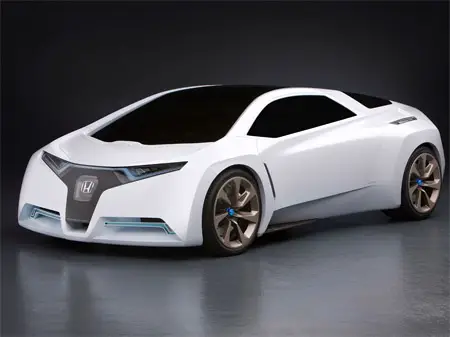
Hydrogen Sports Car Future


Honda FC Sport Design Study Suggests Hydrogen Sports Car Future, Honda today revealed the Honda FC Sport design study model, a hydrogen-powered, three-seat sports car concept, at the 2008 Los Angeles Auto Show.

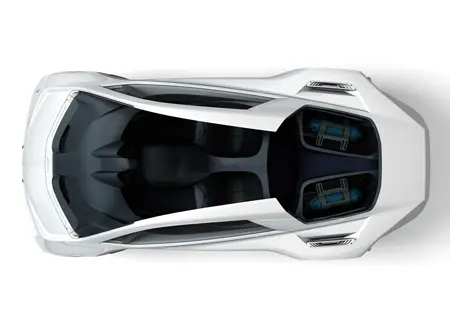
The FC Sport emphasizes the design flexibility and potential of Honda’s V Flow fuel cell technology – already deployed in the Honda FCX Clarity sedan – and reconfigures it into a lightweight sports car design with an ultra-low center of gravity, powerful electric motor performance and zero-emissions. The design study concept is inspired by supercar levels of performance through low weight and a high-performance, electrically driven fuel cell powertrain.

“The Honda FC Sport explores how to satisfy automotive performance enthusiasts in a world beyond petroleum,” said Dan Bonawitz, vice president of American Honda Motor Co., Inc. “People who love sports cars will still have a reason to love in a hydrogen-powered future.”

The high-output Honda fuel cell powertrain and a sleek, aerodynamic body contribute to the vehicle’s performance potential. A modular approach to fuel cell component packaging and the electric drivetrain contribute to the FC Sport’s low center of gravity with the majority of vehicle mass distributed between the axles, creating the balanced weight distribution sought after in sports cars.

Sunday, 3 July 2011

Porsche's new 2007 911 GT3


Porsche's new 2007 911 GT3 made its public debut at the Geneva Motor Show on February 28, 2006. The latest race-bred 911 sports coupe features a 415-horsepower naturally aspirated engine with an 8,400 rpm redline, an active suspension setup tuned for the track, and a mechanical limited-slip differential.

Serving as the homologation basis for Porsche's 911 GT3 RSR racecar, the 911 GT3 provides enthusiasts with an uncompromising road car that can easily transition to weekend track-day outings. The 415-horsepower, 3.6-liter flat-Six engine produces a specific output of 115.3 horsepower-per-liter, among the highest of any naturally aspirated production car. The Boxer engine's power peak is reached at 7,600 rpm, on the way to an 8,400 rpm redline -- 200 rpm beyond the previous GT3 model.

In addition to its high-revving characteristics, the Porsche GT3 engine's performance has been fortified by careful attention to airflow rates. Changes to the variable intake system include a throttle valve enlarged from 76 to 82 millimeters, optimized cylinder heads, and a low-backpressure exhaust system.

To take advantage of the extended-rev characteristics of the engine, the 2007 911 GT3 features a revised six-speed manual transmission, with lower gear ratios for 2nd through 6th, as well as shortened shift-lever throws. A new change-up display, which illuminates the tachometer shortly before the relevant engine speed is reached, provides GT3 pilots with an additional signal to optimize shift timing.

The combination of a more powerful, higher-revving engine and shortened gear ratios produces impressive acceleration figures, allowing the 2007 911 GT3 to reach 60 mph from a standstill in 4.1 seconds, and 100 mph from a standing start in 8.7 seconds. The top test-track speed of the new 911 GT3 is 193 mph.

For the first time, the 911 GT3 boasts an active suspension. The standard Porsche Active Suspension Management (PASM) system offers two chassis in one: the basic configuration is similar to that of the previous model and is suitable for driving on alternating road surfaces. In Sport mode, the system provides even firmer damping, enabling more focused dynamics for the racetrack.

For the best possible transmission of engine power to the road, the GT3 is equipped with a comprehensive traction package, including new electronic Traction Control adapted from the Carrera GT, standard-equipment 19-inch sports tires, and a mechanical limited-slip differential. The new Traction Control setup features traction-slip and drag-torque control functions, allows the safe application of power under any driving conditions, and can be completely disabled if desired.
Tuesday, 28 June 2011

Ghost Rolls-Royce


Car Exhibition Indonesia International Motor Show (IIMS) more festive by the presence of Ivan's Motors and Blinkz-Blinkz. Supplier of the cars were worth billions of displaying the cars that do not normally found in the streets of the homeland.

What? Familiar with the Ghost Rolls-Royce Ghost? Well, the car appeared to semi-permanently in the hall in front of Hall C. There is also the petite fast Porsche 911 Turbo and lamborgini LP 552-2 Valentino Balbonia and rival Ferrari California.

Moving into the little there is the Audi R8 Spyder, the car used in the iron man Iron Man. There are also not spared Camaro SS turbo, Mini Cooper JCW, Escalade Platinum, Audi TT RS Roadster, BMW X6 M and New Aston Martin V8 Vantange.

"These cars we display only. We just showed that Indonesia also have these expensive cars. If visitors want to buy just come to our show room," said Vivi-sales Blinkz detikOto Blinkz when encountered.

Range of exotic cars that had managed to look stunning. Sexy body to make the visitors amazed to discover the price of the cars were turned out to billions. No doubt a camera in his pants pockets issued only to get a photo of exotic cars.

Well, not willing to do if you did not get to see the luxury car. Thus it came to the IIMs in the JI Expo Kemayoran. Because the event will end at 1 Agsutus 2010. Do not forget to bring your camera yes.

Monday, 20 June 2011

Spyder super sports car


Stuttgart. Today is the day that Dr. Ing. h.c. F. Porsche AG, Stuttgart, puts on sale the 918 Spyder super sports car with its innovative plug-in hybrid drive. Production development is proceeding apace in the wake of the outstanding customer response to the concept car unveiled at the Geneva Motor Show 2010. Thanks to its unique hybrid technology, the 918 Spyder is estimated to consume a mere three litres of fuel per 100 kilometres (94 mpg imp.) based on the New European Driving Cycle (NEDC). Its V8 engine delivers more than 368 kW (500 hp), assisted by two electric motors with a total of at least 160 kW (218 hp). The 918 Spyder is available for immediate order priced from 645,000 Euro – subject to VAT and country-specific charges.

To ensure a 918 Spyder’s exclusivity, the two-seater is limited to no more than 918 units. The earlier a customer orders his vehicle, the earlier it will be delivered, as production is initialised in the same sequence in which orders are received. Production of the 918 Spyder is scheduled to commence on 18 September 2013 – 9/18 in US date convention – in a quasi manufacturing operation at Porsche’s main plant in Stuttgart-Zuffenhausen. Delivery of the initial vehicles will commence in November 2013.

The design’s DNA is derived from the Carrera GT and Porsche 917 sports car as well as the RS Spyder and is very closely modelled on the 2010 concept car. Unlike the concept car, however, the production version of the two-seater, based on a carbon fibre-reinforced plastic monocoque, features a manual roof system with removable roof panels that can be stowed in the front luggage compartment.

The 918 Spyder is driven by a unique type of plug-in hybrid system. It comprises a high-revving V8 engine with a displacement exceeding four litres and output of more than 368 kW (500 hp). The mid-engine power unit is based on the racing engine of the successful Porsche RS Spyder, which provided impressive proof of its efficiency with its multiple victories in the Michelin Green X Challenge in the American Le Mans Series, the Le Mans Series and the 24 Hours of Le Mans. Power transmission to the rear wheels is by means of a compact, seven gear Porsche-Doppelkupplungsgetriebe (PDK). This is complemented by two electric motors – one each on the front and rear axle – with a joint mechanical output of at least 160 kW (218 hp). This configuration offers an innovative, variable all-wheel drive with independent control of the propulsion force on both axles. The energy storage unit is a liquid-cooled lithium-ion battery that can be charged from a conventional domestic power socket, delivering a range in excess of 25 km (16 miles) in the NEDC on purely electric power. The charging time depends on the country-specific mains network, being approximately three hours in Germany, for example. A quick charging option is planned to reduce charging time yet further.

The 918 Spyder’s combined total fuel consumption in the NEDC (ECE-R 101) is anticipated to be 3.0 l/100 km (94 mpg imp.), equating to CO2 emissions of 70 g/km (112 g/mile). Despite that, the super sports car offers performance of the highest order. It accelerates from a standing start to 100 km/h (62 mph) in a maximum of 3.2 seconds and has a top speed of more than 320 km/h (199 mph). That means the Spyder will be able to manage a lap of the Nürburgring Nordschleife in less than seven minutes and 30 seconds – trumping the Porsche Carrera GT, which needs seven minutes and 32 seconds. The top speed on purely electric power is 150 km/h (94 mph). To shorten the time the customer has to wait for the 918 Spyder, Porsche is offering everyone placing an order the exclusive opportunity to acquire a 911 Turbo S “Edition 918 Spyder”, also limited to no more than 918 units. Visually, both inside and out, the special edition is inspired by the 918 Spyder's characteristic individual features. That includes the distinctive acid green features such as the specific and part-embroidered model logos and seams, the instrument cluster needles, the specific PCM screen and illuminated door entry guards. The limited edition badge on the glove compartment lid bears the same number as the 918 Spyder the customer has ordered. The 911 Turbo S “Edition 918 Spyder” can also be ordered in the same colour. Both the technology and basic equipment of the new 911 Turbo S “Edition 918 Spyder” are based on the 530 hp (295 kW) 911 Turbo S. In the case of the special edition, the already comprehensive standard equipment is complemented in particular by an enhanced leather interior, a special instrumentation version and additional carbon elements both inside and out. The 911 Turbo S “Edition 918 Spyder” is being offered to coincide with the commencement of sales of the 918 Spyder with deliveries starting in June 2011. The Coupé version of the special edition costs 173,241 Euro in Germany and 184,546 Euro as a Cabriolet – including VAT and country-specific equipment items respectively.